
The third quarter brought two very different stories across the financial markets. While 2026 has been a strong year for equities overall, the pace of gains moderated during the quarter. Meanwhile, rising interest rates put pressure on the bond market, reminding us that stocks and bonds can face very different challenges at the same time.
Interest Rates & The Bond Market
The Federal Reserve raised its benchmark interest rate by 0.25% on September 16, citing persistent inflation. By the end of September, Treasury yields had climbed significantly, with the 10-year Treasury yield reaching approximately 5.00% and the 30-year Treasury yield reaching 5.64%.
When interest rates rise, existing bond prices generally fall. Longer-maturity bonds tend to be more sensitive to these movements, which can create greater short-term volatility for investors holding longer-duration fixed-income investments.
The outlook for interest rates remains uncertain. Persistent inflation, higher energy prices, increased government borrowing, and rising corporate debt issuance have all contributed to upward pressure on yields.
While rising rates can create short-term challenges for existing bondholders, they also present opportunities. Higher yields allow investors to purchase new bonds at more attractive income levels and potentially improve the long-term income generated by a portfolio.
Rather than trying to predict the next move in interest rates, we will continue to focus on diversification, credit quality, appropriate maturity selection, and alignment with your financial plan.
The Stock Market & The Midterm Election Cycle
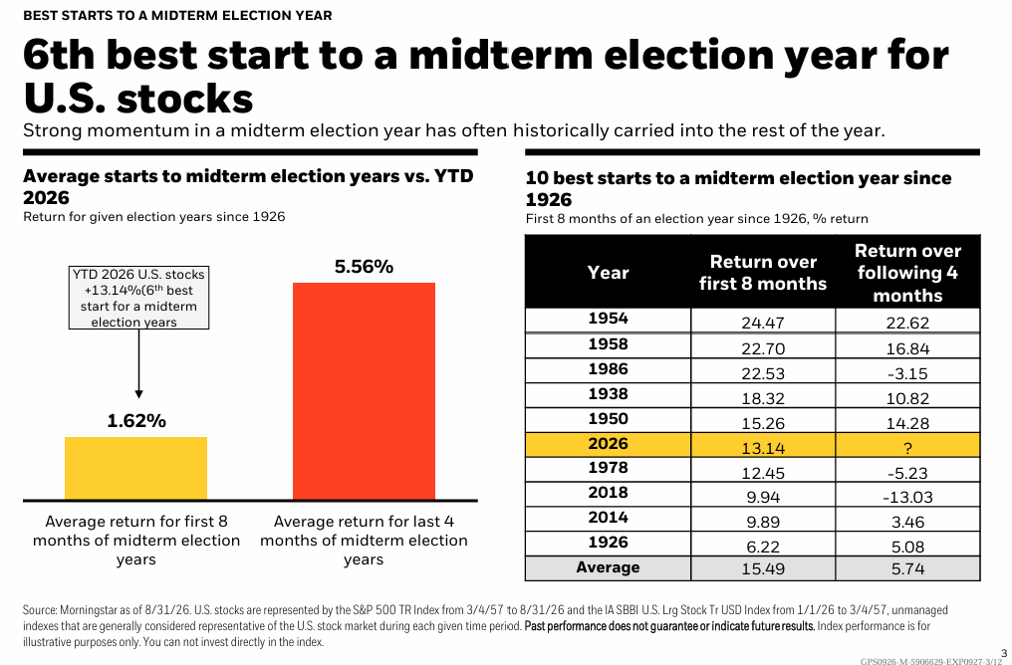
On the equity side, U.S. stocks have enjoyed one of the stronger starts to a midterm election year in history. According to our friends at BlackRock, 2026 ranks as the sixth-best start for U.S. stocks during a midterm election year.
As we often remind clients, the stock market does not have a political party. While election headlines can create uncertainty and short-term volatility, our focus remains on the underlying fundamentals of the economy and the companies in which we invest.
We would not be surprised to see additional volatility as we approach the November midterm elections. Historically, markets have sometimes rallied as election uncertainty clears, regardless of which party wins. However, neither a pre-election pullback nor a post-election rally is guaranteed.
Our friends at BlackRock have provided the chart below to illustrate the historical market pattern during midterm election years.
So what has been driving the market?
Healthy corporate earnings and relatively stable employment have helped support equity returns. In our opinion, one of the biggest drivers has also been the enormous amount of investment in artificial intelligence (AI).
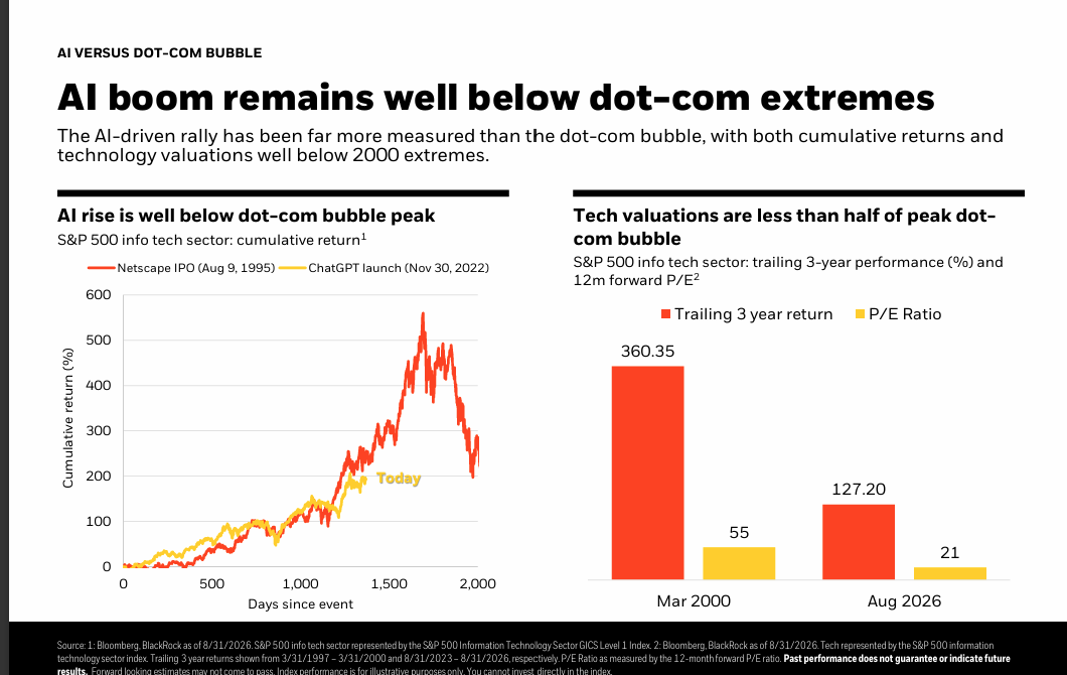
We continue to have conversations with clients about whether today's AI investment boom resembles the technology bubble that peaked in March 2000. There are certainly risks that expectations and valuations in parts of the AI market could become excessive. At the same time, the current environment has important differences from the dot-com era.
We thought the following chart offered a useful comparison of today's AI investment cycle with the technology boom of the late 1990s.
Only time will tell how this cycle ultimately unfolds. Our role is not to predict the exact peak or bottom of a market cycle, but to help ensure that your investments remain appropriately diversified and positioned to support your long-term goals.
As we emphasize in all our correspondence, the key to long-term financial success is a diversified portfolio paired with a well-designed financial plan.
Housekeeping & Thank You
We are incredibly grateful for your continued trust and for the role you have played in helping Horst & Graben grow. We are excited to share that we surpassed $1 billion in assets under management in 2026!
This milestone is a reflection of the relationships we have built with our clients, and we do not take that trust for granted. As our firm continues to grow, you will see some new faces on our team, all committed to delivering the personal service and thoughtful advice you have come to expect.
We are excited to introduce you to Danica Sachs, who joined Horst & Graben after transitioning into the financial services industry in 2024 with Merrill Lynch. Before entering finance, Danica spent more than a decade working as a curator, critic, and artist liaison in the art world.
Through her work in San Francisco and Portland, Danica recognized that when money is involved, people benefit from having a trusted advisor who can demystify financial decisions and help them establish meaningful goals.
Her unique background also equips her to help clients incorporate unusual or illiquid assets into their broader financial plans.
Danica grew up in the Willamette Valley and graduated from Whitman College with degrees in English and Art History. She also holds master's degrees in Arts Administration and Art History from the School of the Art Institute of Chicago.
Outside the office, Danica enjoys trying new recipes at home, skiing on winter weekends, relaxing at the beach, and spending time outdoors with her family and labradoodle. She loves an adventure, and some of her favorite places she has visited or lived include Vietnam, Cairo, Amsterdam, and Maui.
We are thrilled to have Danica on the team and look forward to introducing her to more of you.
Year-End Planning: 2026 Retirement Contribution Limits
As we enter the fourth quarter, now is a great time to review your retirement plan contributions and make sure you are on track to take full advantage of the available limits. Catch-up contributions depend on eligibility and plan provisions. Certain SIMPLE plans have higher regular contribution limits, and special rules apply to catch-up contributions. IRA contributions are also subject to earned-income requirements and, depending on the type of IRA, income eligibility and deductibility rules.
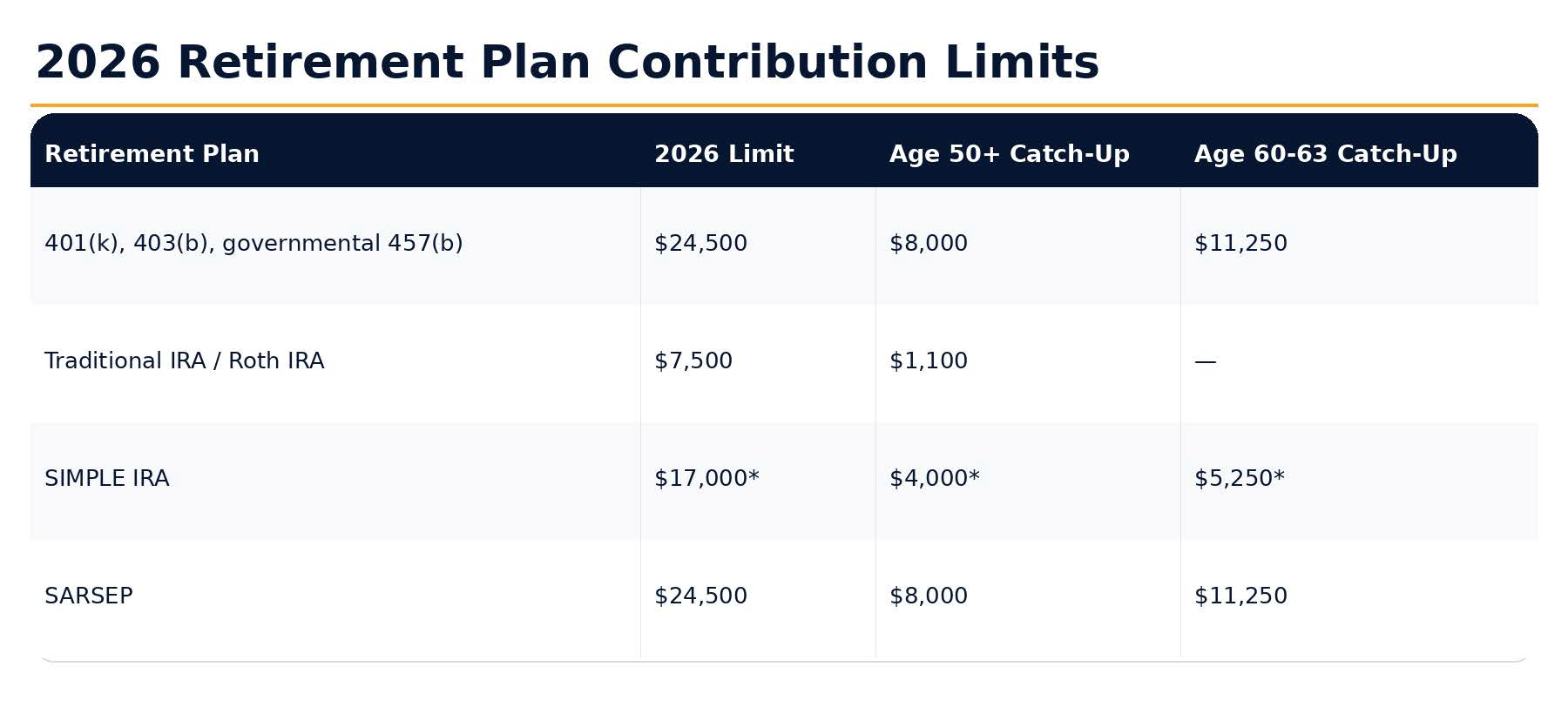
*Catch-up contributions depend on eligibility and plan provisions. Certain SIMPLE plans have higher regular contribution limits, and special rules apply to catch-up contributions. IRA contributions are also subject to earned-income requirements and, depending on the type of IRA, income eligibility and deductibility rules.
A few reminders as you review your year-end planning:
· Review your workplace plan contributions. Check your year-to-date contributions and remaining pay periods to determine whether you are on track to reach your desired limit.
· Consider catch-up contributions. If you are age 50 or older, additional contributions may be available. Those turning 60, 61, 62, or 63 in 2026 may qualify for the higher catch-up limit.
· Coordinate contributions across plans. If you participate in more than one employer retirement plan, certain employee contribution limits apply across plans.
· Review your overall tax strategy. Retirement contributions, Roth conversions, charitable giving, and other year-end planning opportunities may work together to improve your overall financial picture.
If you have questions about your contributions or would like to review any year-end planning opportunities, please reach out. We are happy to help you determine what makes the most sense for your circumstances.
Thank you again for your continued trust in Horst & Graben. We appreciate the opportunity to work with you and your families, and we look forward to helping you navigate the opportunities and challenges ahead.